Posts

Showing posts with the label Popular Science

Everyday Queueing #3: Why Airplane Boarding Feels So Inefficient

Image
I used to pay little attention on boarding at the airport because of my elite status with various airlines. But retirement has kept me grounded and almost swiped my record clean in recent years. Recent trips, including one to Colombia with an infamous American airline, had me thinking more about the science behind plane boarding.   Anyone who has boarded an airplane enough times has likely experienced the strange choreography that unfolds before takeoff. Passengers stand up almost immediately when boarding begins, lines begin forming long before their assigned group is called, and eventually a slow procession starts moving toward the aircraft. For a few moments the line appears to flow smoothly. Then everything stops. Someone is lifting luggage into an overhead compartment. Another passenger realizes they are seated twenty rows further back. A family begins negotiating seating arrangements while the rest of the line quietly waits. Movement resumes briefly before another i...

Everyday Queueing #2: Why the Fastest Lane Often Becomes the Slowest on Highways

Image
There is a familiar ritual that unfolds on highways almost every day. You are driving in moderate traffic when a neighboring lane begins moving slightly faster than yours. At first, the difference is subtle. A few cars pull ahead, creating the impression that a better option exists just a few meters away. Almost instinctively, your attention shifts. You begin comparing speeds, scanning gaps, and calculating whether a lane change might save time. Eventually, convinced that an opportunity has appeared, you switch lanes with quiet confidence. For a brief moment, the decision appears justified. The new lane moves smoothly and the cars around you continue forward. Then something strange happens. The lane slows. Vehicles begin compressing together. Meanwhile, the lane you just abandoned suddenly starts moving. Cars you previously passed now drift ahead while you sit wondering whether traffic possesses a strange sense of humor. Experiences like this are common enough that many drivers jokin...

Everyday Queueing #1: Why the Shortest Checkout Line Is Sometimes the Wrong Choice

Image
There is a small ritual that almost everyone performs at supermarkets. We scan the checkout area, count the number of people in each line, glance at shopping carts, and make a quick calculation in our heads. The logic seems obvious: fewer people should imply less waiting. Yet many of us have experienced the strange frustration of watching a longer line move faster while ours becomes trapped behind a price check, a failed barcode scan, or a customer searching endlessly for a wallet. At first glance this feels like bad luck, but mathematics suggests something more interesting may be happening. Most people treat supermarket checkout as a simple optimization problem. You arrive, observe a few lines, and choose the one with the smallest number of people. The assumption is intuitive: fewer customers should imply shorter waiting time. However, this ignores the fact that queueing systems are not governed by headcount alone, but by stochastic service dynamics. In queueing theory, the system is...

An Unusual Perspective and Strategy on Wordle

Image
You must have heard of (and maybe for some, forgotten about) Wordle .  This five-letter word guessing game took the world by storm earlier this year.  Despite losing some of its shine by now, many are still considering it their daily routine.  I know people who eagerly anticipate the stroke of midnight so they can be the first ones to crack the daily puzzle.  This New York Times darling actually reminds me of the long running TV show Wheel of Fortune  especially its bonus round. Pat Sajak's reciting of the gimme letters  R, S, T, L, N, E still seems like a memory from yesterday.  If I seem to know too much about this show, this is because I watch it on Netflix when feeling the need for an extra challenge in life.  This post was written to commemorate the 100th anniversary of my playing the game.  For full disclosure, I do not play every day especially when the schedule gets tough.  My record is not too shabby however, as I guess the...

Book Review: Range: Why Generalists Triumph in a Specialized World

Image
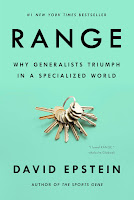
I have always prided myself on leading a meaningful life.  Neither a Nobel laureate nor celebrity, but there is a sense of "balance" that makes my days mostly enjoyable.  A strong career, adequate finances, a loving family and fun hobbies all contribute to the experience.  Though not by design, I have perhaps a become a "generalist" in life.  I finished the book,  Range , a couple months ago and enjoyed it immensely.  David Epstein did a superb job highlighting the importance of generalists in today's world. Here are my key takeaways:  The book started by comparing two schools of thoughts on raising successful athletes.  Tiger Woods vs Roger Federer , two undisputed all-time greats in their respective genres. What is more, Woods represented the deliberate training camp while Federer was exposed to a range of sports both from a young age.  This clever comparison intrigued me to find out whether range can prevail over focused deliberate t...

What is Genius? Part V - Environmental Circumstances and Conclusion

Image
My previous posts explored internal contributors to genius, but one external factor cannot be overlooked.  Environmental circumstances are essential to genius.  Being at the right place at the right time, having the right family, teacher (or mentor) are keys to one's success.  Some say this is luck, but I say it is more.  The stars essentially have to align for a genius to become a genius. Take Terence Tao for instance, widely recognized as one of the best minds in mathematics today.  He was born in Australia to Chinese parents who emigrated from Hong Kong.  Winner of the Fields medal at 31, Tao was a child prodigy.  His father was a doctor; his mother a math and physics teacher.  Hence the brains.  Early on, Tao's parents encouraged their  son to learn at his own (fast) pace and his elementary school tailored a specialized gifted program for him.  Tao surely has intelligence, creativity (in order to win the Nobel equivalent in mat...

What is Genius? Part IV - Grit

Image
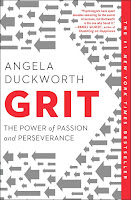
Thomas Edison once said "Genius is one percent inspiration and ninety-nine percent perspiration." He is best known for the invention of the electric lightbulb, and had more than a thousand patents under his belt.  Edison wanted to convey that hard work and perseverance, more than anything, are needed for greatness.  These days I think of "perspiration" as grit.  Angela Duckworth, a best selling author and speaker, defines grit as  passion and sustained persistence applied toward long-term achievement.  It is not just hard work, but   toiling relentlessly on a passion you stay loyal to despite ups and downs.  Especially the downs. It was generally believed that grit is somewhat genetic, but we now know it is mostly an acquired trait.  Just like IQ tests, Duckworth created a grit scale , which computes a subject's passion and perseverance ratings before yielding a final grit score.  It is often easy to overlook the role of passion in ...

What is Genius? Part III - Creativity

Image
Creativity is an elusive concept. Googling the word returns a dozen definitions that seem correct at first glance, but none effectively captures its full essence.  I tend to favor simplicity and subscribe to  this portrayal: creativity is the ability to create new ideas or things.  In some ways, creativity is more complex than intelligence.  First it is harder to identify because there are no standardized creativity tests today.  While intelligence quotient (IQ) is a household term, there is yet to be a creativity quotient (CQ). That said, answering aye to most of the following questions is a good tell that you may be creative:  Do you have a curious mind? Are you open to new experiences?  Do you like to take risks?  Do you like to daydream?  Do you have a rebellious spirit?  Are you highly sensitive to the world around you?  Do you catch yourself wondering "what if"?  Is your workplace messy?  Creativity is also less conc...

What is Genius? Part II - Intelligence

Image
Needless to say, intelligence has traditionally been a key component to the genius label.  But do we really know what it means? In simplest terms, intelligence is the ability to acquire and apply knowledge and skills. It is not exactly smarts however, because smarts can be earned through learning while intelligence is innate. How can we measure intelligence? Well, you must have heard of IQ tests. IQ stands for intelligence quotient, which is essentially a score for measuring how intelligent you are.  There are many so-called tests on the Internet, but only two are internationally recognized: WAIS-IV and SB5.  The one I took in 2021 was the WAIS-IV, placing me in the high end of the IQ spectrum.  Contrary to conventional wisdom, these tests are more than just gauges of logical reasoning.  The WAIS-IV has four components, which spans perceptual reasoning, verbal comprehension, working memory and processing speed.  See here  for an understanding of scores...

What is Genius? Part I - Introduction

Image
The word  genius  carries a uniquely satisfying connotation.  There are probably many definitions of the term, with most narrowly focusing on people with extremely high intelligence.  To me, a more encompassing definition is preferred:  A genius is someone who is exceptionally talented in his/her field(s) and creates meteoric contributions to the world.     Einstein fits the bill but so do Michelangelo, Mozart and Kasparov.  Debates have gone for centuries on what makes a genius a genius.  Recent studies have shown that it is not all about brains.  Nature vs nurture debates have ensued, but I will settle on these four essentials:  Intelligence - yes, brains Creativity - also brains  Grit - persevering through highs and lows  Environmental circumstances  - being at the right place at the right time with the right people Let's spend the next few weeks to deep dive on each characteristic that help to shape a genius....

9 Equations a True Geek Should Know

Came across this  article  which is entertaining to read while keeping score!  I scored 2 of 9 - Uncertainty Principle and Maxwell's Equations. The good news is I do not qualify as a geek, but that also means there is so much more to learn when I retire. -PTS

eBay for Science?

Almost a month into baby raising and I have caught my wind to blog again. Just the other day, I stumbled upon (no pun intended) this website called Science Exchange . The concept is quite simple as it is a platform for outsourcing scientific experimental projects to the lowest bidder. Think of it as eBay for services, the twist being the lowest bid wins. I believe this is a great idea for academic institutions to better collaborate and take advantage of each others' resources in economic ways. I do not have any pending experiments but set up an account anyway for exploration. Hope this concept catches on! -PTS

Thor and the Einstein-Rosen Bridge

Relocation always takes a toll on one's life.  I am speaking from experience as this is my second move in 2 years.   Worst of all, the 9 to 5 in Hong Kong is sometimes like the 9 to 10, especially when you work in a foreign company and expected to do early morning or evening meetings with North America. As a result, I have lost a lot of blogging time. Luckily, I recently managed to squeeze in time to watch the movie Thor , in 3D! I went to the movies not expecting any physics lessons, but Natalie Portman mentioned a number of astrophysics concepts, including the Einstein-Rosen Bridge that connected Asgard to Earth. In a layman's world, this bridge is more commonly known as a  wormhole . A wormhole is essentially a warp in space-time, thus creating a shortcut for traversing between two physical points in space and time. Think of the analogy of drawing two points on a piece of paper placed on a table. When the paper is lying flat, the distance between the two po...

Supporting a Kickstarter Project

In the midst of packing and cancelling bills, I finally managed to squeeze in time to blog.  A project at Kickstarter  that I have been supporting has kicked off at last. The project is called "A History of the Future in 100 Objects." The author will try to create podcasts and author a book on 100 objects representative of the 21st century. As we have only lived 10% of the century, most of these objects will only be predictions.  In fact, people who contribute enough can put their own predictions to work with the author.  I love this collaborative approach and look forward to seeing the end product! -PTS

Watson Beats Human Champs on Jeopardy!

Image
It is official: IBM's Watson, a supercomputer equipped with terabytes of RAM, was crowned champion of champions on Jeopardy this week. It smashed the show's two most accomplished human Jeopardy contestants ever by a mile. Prior to this challenge, Ken Jen and Brad Rutter both won over $3M USD on Jeopardy! It is amazing how far artificial intelligence has come over the years.  I was especially impressed with Watson's ability to interpret the play of words often found in Jeopardy-styled clues (or answers). Apart from the occasional mishaps when it completely missed the mark, Watson did extremely well even in categories like "Familiar Sayings" that require a certain level of intuition.  Enjoy this clip on the final 10 minutes of the competition: In 1997, IBM's Deep Blue defeated fellow human grand masters like Garry Kasporav. Fourteen years later, we have a Jeopardy champ that does not require food or sleep.  One cannot help but wonder what next to expect in ...

Tropical Cyclones

Tropical Cyclone Yasi hit Queensland, Australia a few days ago, causing millions of dollars in damages.  The silver lining in this unfortunate episode, is that it missed areas of concentrated populations. It is worth noting that the sheer size of the weather system would have wreaked much more havoc  had it hit elsewhere.   What is a Tropical Cyclone A tropical cyclone is essentially a spiraling mass of wet air centred around an area of low atmospheric pressure most commonly known as the "eye". On the ocean, a cyclone is continually fed as evaporated water from the ocean surface condenses, releasing more heat as the air current rises. Owing to the  Coriolis effect , a cyclone spins counterclockwise in the Northern Hemisphere and clockwise in the Souther Hemisphere. Strength Categories According to the Saffir-Simpson Hurricane Scale, Yasi was a category 5 cyclone, the strongest of its kind. It reached wind speeds of 250km/h, and storm surges of greater than 18ft....

The Physics of Whip Cracking

I tried my hands on whip cracking in an Aussie sheep farm tour late last year.  Interestingly, whip cracking in Australia has gained enough prominence to be a competitive sport! I must admit that the whip is not my forte, as I could only get it cracking 10% of the time (when I am not hitting myself with it).  Staring at defeat, I decided to learn the science behind this in hope of conquering it some day. It turns out a whip cracks because a sonic boom is created at its tip or topper. A sonic boom is created when an object travels at supersonic speeds such that its surrounding waves of air pressure are compressed into a single shock wave at the speed of sound. The logical question then: what is travelling so fast in the whip? Well, it's the tip. Why? Conservation of momentum! Let's picture this: when you apply a force to a whip, the initial loop motion and wave are applied to the thong, which has a much larger mass than the whip's tip. It is worth noting that momentum...

Prime Numbers and Encryption

Want to make   $250 000 ?  Find a big prime number, a really big one. It turns out there are organizations  ready to dough out good cash for a really large prime number.  This is because primes are used in   RSA cryptography . RSA Algorithm Let's look at the algorithm: 1.       Multiply two large prime numbers  p  and  q  to get the product  N 2.       Find two numbers  e  and  d , such that  ed = 1mod((p-1)(q-1)) , where  e  and  N  are relatively prime meaning they do not share any prime factors. 3.       Let's call  M  the original message and  C  the ciphered message:  a.       To encrypt: C = M e mod(N) b.       To decipher: M = C d mod(N)  In essence, using the public key   ( N,e)  will...

The Colours of Water - From The Caribbean to the South Pacific

Image
Last year, I took a number of vacations which involved cruising, diving, snorkelling and walking on glaciers. Thinking back on those trips, I could not help but notice that water and ice exhibited different colours in different settings.  I decided to dive deeper into the colours of water. Finally, here are my findings. Water’s True Colour The colour of an object mainly depends on the colour of light emitted from it. In the case of water its colour is also affected by factors like light source, absorption, scattering, and suspended materials. Absorption by water is stronger for red light, but weaker for blue light. Water is therefore, intrinsically blue. However, this effect is only apparent when the water is reasonably deep. This is why a glass of water appears colourless whereas a big aquarium looks bluish through the thickness of water. Why is the Sea Blue? I did two cruises last year, one in the Caribbean and the other in the South Pacific. Owing to the depth of the wate...