Last year, I took a number of vacations which involved cruising, diving, snorkelling and walking on glaciers. Thinking back on those trips, I could not help but notice that water and ice exhibited different colours in different settings. I decided to dive deeper into the colours of water. Finally, here are my findings. Water’s True Colour The colour of an object mainly depends on the colour of light emitted from it. In the case of water its colour is also affected by factors like light source, absorption, scattering, and suspended materials. Absorption by water is stronger for red light, but weaker for blue light. Water is therefore, intrinsically blue. However, this effect is only apparent when the water is reasonably deep. This is why a glass of water appears colourless whereas a big aquarium looks bluish through the thickness of water. Why is the Sea Blue? I did two cruises last year, one in the Caribbean and the other in the South Pacific. Owing to the depth of the wate...
Towards the end of 2024, I left the 9 to 5 routine given my financial goals were achieved. It felt great not needing to hug my phone to sleep and being able to wake up at whatever godly (or ungodly) hour desired. Fast forward six months, the retirement routine became mundane. I needed to find meaningful use of my newly found time. Between street and league soccer, writing a book, exotic getaways, relocation back to my adopted home country, all the while taking on advisory gigs with interesting companies, life seemed like a handful. Somehow, I managed to find time to study various topics of interest. One topic that really caught on was game theory. Learning game theory was a self-improvement initiative. I wanted a life broader horizon and be better equipped when when dealing with others. My definition of game theory is the study of interactive decision making of more than one party, where the outcome of each particpant or player...
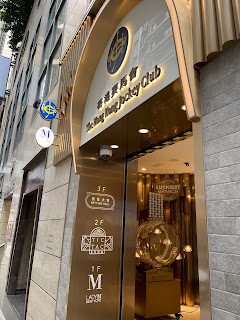
The Hong Kong Jockey Club (HKJC) owns all government approved sports betting and lottery stations in Hong Kong. These establishments normally offer few reasons for me to visit. But I recently ventured into one HKJC venue. This Stanley Street branch in busy Central has won the title of the luckiest (or most unlucky if you are the HKJC) betting site in recent years. Quite a few have won the grand prize in lottery, known locally as Mark Six, from this premise. The shop has recently undergone a major facelift. It now houses two restaurants, various horse racing and lottery artefacts, along with fun facts showcases. Upon entry, there is an unexpected caravan setting that provides a homey feel for visitors. A real lottery ball drum machine is also on display. Opposite it is a historical wall detailing the evolution of Mark 6 over the years. Did you know that the lottery went from thirty-six numbers in 1976 to forty-nine in 20...


Comments
Post a Comment